Centrifugal Feeder vs Vibratory Bowl Feeder: Which Hits 1,200 ppm? (2026)

The 1,200 ppm Question
The cleanest reason engineers ask "centrifugal or vibratory?" in 2026 is throughput. Lines that used to run 400–600 parts per minute on a single vibratory bowl are now being asked to deliver 1,000–1,500 ppm to feed faster robots, faster fillers, faster assembly cells. At that ceiling the two technologies separate cleanly: vibratory bowl feeders are predictable up to 600–800 ppm; centrifugal feeders unlock 1,200–3,000 ppm for parts that geometry allows.
This guide is the practical decision tool for that question. We compare the two technologies across the eight criteria that actually drive a buying decision, run the math at 1,200 ppm specifically, and give you a one-page decision matrix you can paste into an RFQ. For the detailed pillar reference, start at the centrifugal feeder pillar guide.
How Each Technology Works (60-Second Refresher)
Both feeders solve the same problem — orient parts and deliver them at a controlled rate — but they use different physics.
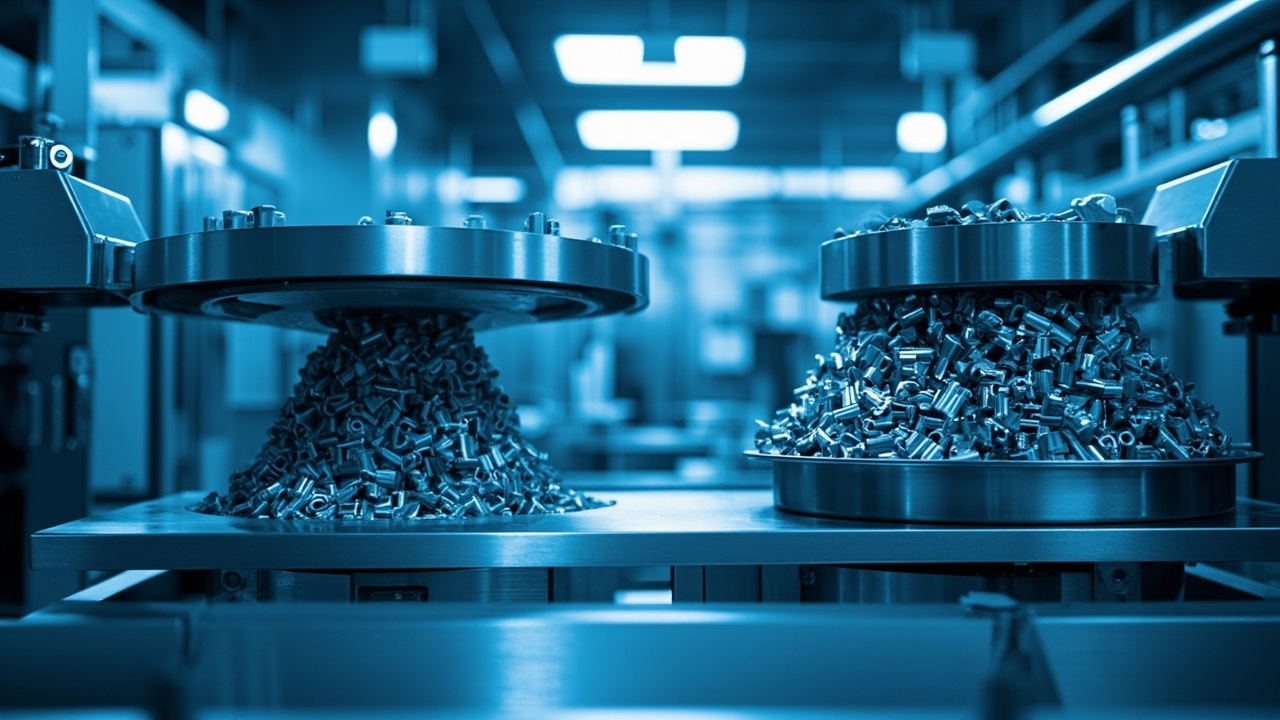
A vibratory bowl feeder uses electromagnetic coils and tuned springs to oscillate the bowl 50–60 times per second. Parts climb a spiral track via tiny "hops" while orientation tooling on the track allows only correctly oriented parts to pass. The motion is pulsed and step-by-step.
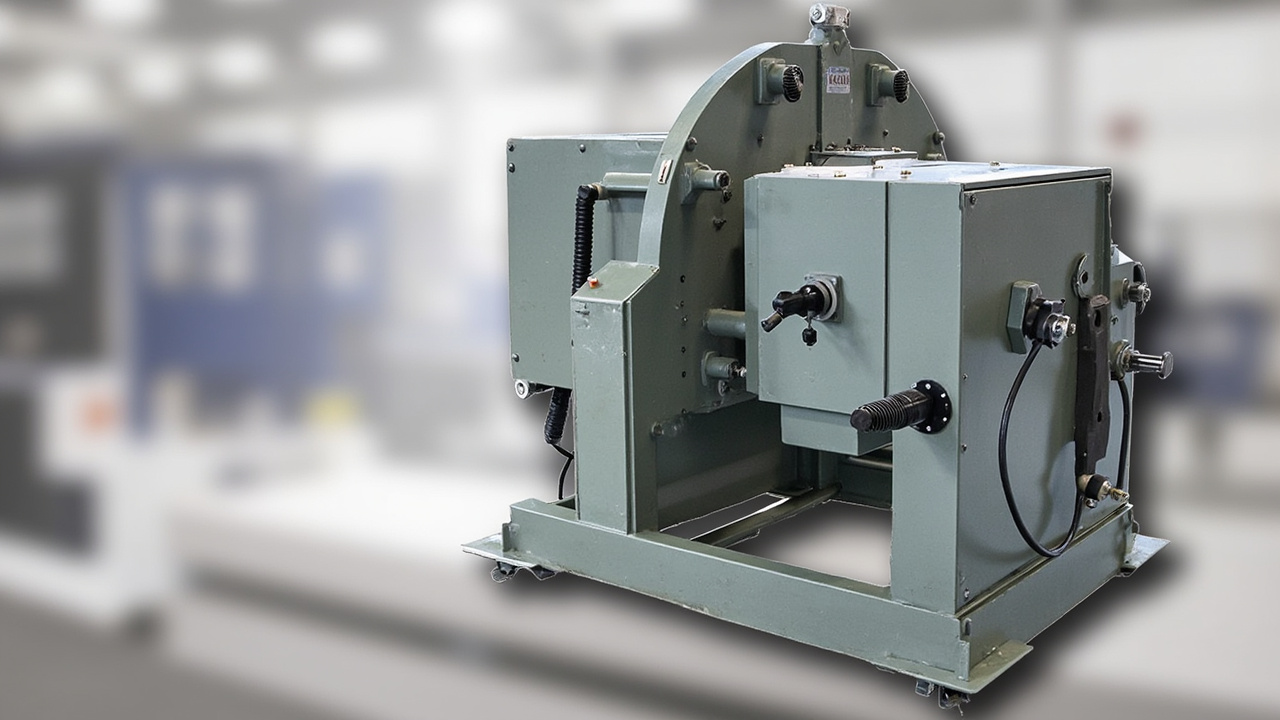
A centrifugal feeder uses a continuously rotating disc or shallow bowl. Centrifugal force pushes parts outward to a peripheral track where selectors orient and discharge them. The motion is continuous and rotational. Because nothing is "lifting and settling" each cycle, throughput is bounded by part flight dynamics rather than by oscillation frequency.
The 8 Criteria That Decide
| Criterion | Vibratory Bowl Feeder | Centrifugal Feeder | Winner |
|---|---|---|---|
| Practical feed rate | 200–800 ppm | 800–3,000+ ppm | Centrifugal at >800 ppm |
| Part complexity | Excellent — multi-axis orientation | Limited to symmetrical / semi-symmetrical | Vibratory |
| Part fragility (cosmetic surfaces) | Tunable, gentle with PU coating | Higher contact forces, edge impact | Vibratory |
| Part size range | 0.5 mm to 200 mm | 2 mm to 50 mm sweet spot | Vibratory |
| Noise (with enclosure) | 72–82 dB(A) | 62–72 dB(A) | Centrifugal |
| Energy / 1,000 parts | Higher at high speed | Lower at high speed | Centrifugal at >800 ppm |
| Changeover flexibility | Moderate (swap bowl + tooling) | Limited (disc + selectors) | Vibratory |
| Equipment + integration cost | USD 9,000–35,000 | USD 14,000–55,000 | Vibratory at low rates |
The pattern: vibratory wins six of eight criteria, but the two it loses — feed rate above 800 ppm and energy/noise at high rates — are the ones that disqualify it from the lines that need them. This is why both technologies coexist instead of one replacing the other. For pricing detail behind the cost line see the centrifugal cost breakdown.
The 1,200 ppm Math
1,200 ppm is the threshold that a lot of buying decisions sit on, and it is exactly where vibratory becomes painful. Here is the practical engineering reality.
What it takes to hit 1,200 ppm on a vibratory bowl
- Part must be small (under 8 mm), light (under 5 g), and simple (single orientation feature)
- Bowl Ø typically 500–630 mm with high-output coil and double-spring stack
- Track angle, feed angle, and wedge geometry tuned tightly — small changes in part lot variation cause big rate drops
- Often requires twin-bowl or specialty designs that approach centrifugal cost
- Practical sustained rate after orientation losses: 800–1,000 ppm
What it takes to hit 1,200 ppm on a centrifugal feeder
- Part must be symmetrical or semi-symmetrical (e.g., washer, cap, simple disc)
- Disc Ø 500–700 mm, AC motor with VFD or low-end servo
- Single selector station typically achieves 1,200–1,500 ppm sustained
- Practical sustained rate: 1,200–1,800 ppm with margin
Practical Rule
If your part is symmetrical and you need more than 1,000 ppm sustained, default to centrifugal. If the part is asymmetrical or fragile and you need more than 1,000 ppm, you typically need a centrifugal pre-feeder + vibratory orientation track in series, or two parallel vibratory bowls — both more expensive than a single technology.
Part-Shape Compatibility Cheat Sheet
Speed alone doesn't decide it. Part geometry decides whether centrifugal is even an option. Use this matrix as a first-pass screen.
| Part Type | Centrifugal Suitability | Vibratory Suitability | Comment |
|---|---|---|---|
| Plain washers | Excellent | Excellent | Either — pick on rate |
| Hex screws & bolts | Good (with selector) | Excellent | Vibratory if multi-thread, centrifugal if single SKU |
| Pins, dowels, rivets | Excellent | Excellent | Either — pick on rate |
| Snap-rings, wave springs | Fair | Excellent | Vibratory better — flexibility hurts disc |
| Bottle caps & closures | Excellent | Good | Centrifugal for high rates |
| Asymmetric stamped parts | Poor | Excellent | Vibratory only |
| Long thin pins (L/Ø > 6) | Poor | Good | Vibratory; specialist track |
| Cosmetic / coated parts | Fair (edge wear risk) | Excellent | Vibratory with PU coating |
| Cylindrical batteries | Excellent | Good | Centrifugal for >1,000 ppm |
| Connector pins (small) | Good | Excellent | Vibratory for orientation; centrifugal for bulk |
For sticky materials and oily parts the calculation is different again — see the horizontal-motion comparison for that case.
5-Year Cost: Like-for-Like at Three Throughputs
The TCO comparison flips at the 1,000 ppm boundary. Below it vibratory is cheaper; above it centrifugal becomes cheaper because the alternative is twin bowls.
| Target Rate | Vibratory 5-Yr TCO | Centrifugal 5-Yr TCO | Lower Cost |
|---|---|---|---|
| 500 ppm | USD 24,000 | USD 32,000 | Vibratory |
| 800 ppm | USD 38,000 | USD 38,000 | Tie — choose by part shape |
| 1,200 ppm | USD 65,000+ (twin bowl) | USD 50,000 | Centrifugal |
| 2,000 ppm | Not feasible single-bowl | USD 70,000–95,000 | Centrifugal (only option) |
Noise & Energy: The Underrated Factors
These two rarely show up in RFQs but they show up in factory walk-throughs. Vibratory bowls are loud — 75–90 dB(A) before enclosure — because parts and bowl walls collide thousands of times per second. Centrifugal bowls are quieter, typically 65–75 dB(A) unenclosed, because part-to-wall collisions are dampened by continuous motion.
On energy, a typical vibratory bowl feeder running 600 ppm draws 0.6–1.0 kW. A centrifugal feeder running 1,200 ppm draws 1.2–1.8 kW. Per part fed, centrifugal is more efficient at high rates because the higher output offsets the higher draw. At 600 ppm vibratory wins on watts/part by a meaningful margin.
Hybrid Configurations That Actually Work
The honest answer in 30% of high-rate projects is: don't pick one — combine them.
- Centrifugal pre-feed + vibratory orientation track — bulk delivery at 1,500 ppm with precision orientation that vibratory does best. Net throughput: 800–1,200 ppm with full multi-axis orientation.
- Centrifugal feeder + vision-guided escapement — vision validates orientation that the disc selector approximated. Used for cosmetic caps and beverage closures.
- Twin centrifugal cells in parallel — when 2,500+ ppm is the requirement and a single disc would tumble. Two 600 mm cells beat one 800 mm cell for reliability.
- Vibratory bowl + accumulator + linear track — when downstream cycles are bursty and the line needs a buffer.
These hybrids cost more than a single feeder, but the alternative is a stalled line and a missed throughput target. Plan for hybrids when feed rate target is >1,500 ppm and parts have any orientation complexity.
One-Page Decision Matrix
Use this matrix once at the start of the project. It eliminates 80% of the technology debate.
| If your project meets… | Recommended Technology |
|---|---|
| Rate < 600 ppm and any part type | Vibratory bowl feeder |
| Rate 600–1,000 ppm and part is symmetrical | Either — pick on changeover need |
| Rate 600–1,000 ppm and part is complex | Vibratory bowl feeder |
| Rate 1,000–1,800 ppm and part is symmetrical | Centrifugal feeder |
| Rate 1,000–1,800 ppm and part is complex | Centrifugal pre-feed + vibratory orientation track |
| Rate > 1,800 ppm | Centrifugal feeder, possibly twin cell |
| Cosmetic / surface-sensitive parts at any rate | Vibratory bowl feeder with PU coating |
| Multiple SKUs with frequent changeover | Vibratory bowl feeder (or flexible feeder) |
FAQ
Is centrifugal always faster than vibratory?
For symmetrical parts, yes — typically 2–3× faster. For asymmetrical parts, no — a centrifugal feeder will simply jam or throw parts off the disc, while a vibratory bowl with proper tooling will orient them at 400–800 ppm reliably. Speed comparison only applies when both technologies can run the part.
Can I retrofit a vibratory bowl to centrifugal?
The bowl, controls, frame, and tooling all change — only the integration cabling and supporting frame are reusable, and only sometimes. Treat a centrifugal upgrade as a new equipment purchase, not a retrofit. The good news: a retired vibratory bowl is often redeployable on a slower secondary line.
Do centrifugal feeders work with small parts under 3 mm?
Possible, but vibratory is usually the better choice. Below 3 mm, centrifugal force on light parts becomes erratic — parts skip, tumble, or stick to disc surfaces. Vibratory micro-feeders handle 0.5–3 mm parts cleanly. The crossover is around 3–5 mm.
Which is better for 24/7 operation?
Centrifugal usually wins on uptime — fewer wear parts, no springs, no electromagnetic coil to fatigue. Mean time between failures is typically 2–3× longer than vibratory. Vibratory wins on serviceability — when something does break, it is almost always a spring or coil and can be swapped in 30 minutes.
How does noise compare in real factory conditions?
Unenclosed: vibratory is 8–12 dB(A) louder than centrifugal. With acoustic enclosures both drop into the 65–75 dB(A) range, but vibratory enclosures must allow tooling access and tuning, which limits how tight they can seal. Centrifugal enclosures are simpler. If your factory has a 75 dB(A) ambient limit, centrifugal needs less enclosure engineering.
What happens if I oversize a centrifugal feeder?
Less than people fear. A 700 mm centrifugal disc running 30% of capacity is no less reliable than one running at 90% — the parts simply spend more time on the disc before being selected. The downside is footprint and capital cost. The upside is headroom for future product mix changes.
Next Steps
Decide first by part geometry, second by throughput, third by cost. If your project lives at 1,000 ppm or above and your parts are symmetrical, the centrifugal answer is almost always cheaper at the 5-year horizon despite the higher equipment price. Send your part drawing and target ppm to Huben Engineering — we will recommend the technology, give you a configured price stack, and walk through the 5-year TCO before you commit. For the deeper engineering reference, see the centrifugal feeder pillar guide.
Ready to Automate Your Production?
Get a free consultation and detailed quote within 12 hours from our engineering team.